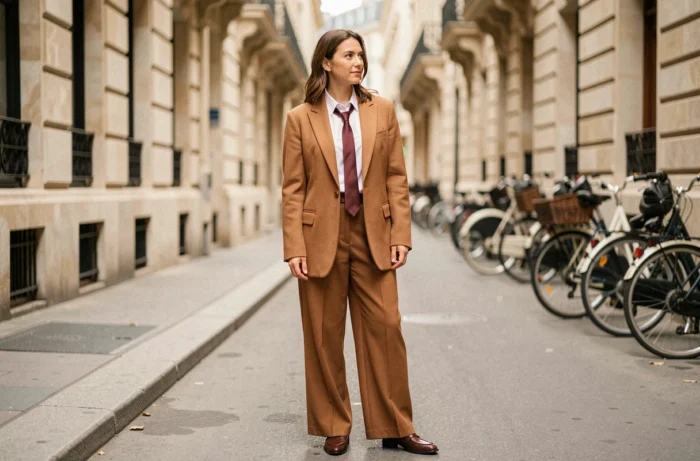
The tie worn by a woman is no longer surprising on the catwalks. Since the Saint Laurent spring-summer 2025 collection, where Anthony Vaccarello showcased a majority of female models in ties, double-breasted blazers, and leather jackets, this accessory has made its way into the everyday women’s wardrobe. The question remains how to wear it daily without falling into the disguise or overly literal citation of the male suit.
Women’s tie and proportions: the basics that guides overlook
Before discussing style, there is a question of volume. A standard tie measures about 8 cm wide and falls below the belt. On a female torso, these dimensions create a visual imbalance that weighs down the silhouette.
Opting for a slim tie, between 5 and 6 cm wide, radically changes the outcome. The fall remains sharp without flattening the bust. The ideal length stops at the level of the navel, not below.
If you wear a fitted shirt, tuck the tie under the collar without tightening the knot completely. A slightly loosened knot, dropped by two centimeters, is enough to break the corporate effect. With an oversized shirt, leave the collar open on two buttons: the tie then lies flat on the fabric, like a textile jewel rather than a uniform.
Several designers now offer models designed for these proportions, and the new arrivals from 2moiselles Happy Lookeuses detail this transition from the male wardrobe to cuts adapted to feminine silhouettes.
Silk, cotton, or knit tie: choosing the material according to the outfit
The material dictates the vibe. Have you ever noticed that the same color looks very different depending on the fabric? This is even truer for a tie, as it draws the eye to the center of the bust.
- Silk provides a sheen that instantly dresses up a look. It works well with a structured blazer or a shirt dress for an effortlessly elegant result.
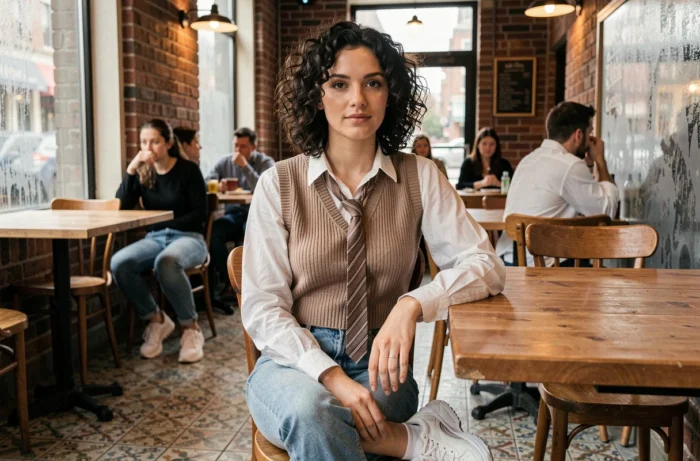
- Cotton or linen are suitable for casual outfits. A straight jean, a tucked white t-shirt, a striped cotton tie: the look holds because the textures are coherent.
- Knitted fabric (square end) remains the easiest to adopt daily. It forgives approximate knots and pairs well with both a fine sweater and a denim jacket.
A common mistake is to wear a shiny silk tie with a matte jersey top. The contrast of textures creates a break that gives the impression of having added the tie as an afterthought. Matching the material register between the top and the tie creates a coherent ensemble.
Tie knot for women: two techniques that suffice
Tutorials multiply complex knots. In practice, two are enough to cover all situations.
The simple knot (four-in-hand)
This is the most asymmetrical and least rigid. It produces a slightly irregular triangle that avoids being too strict. For a feminine look, it is the most suitable because it does not seek perfect symmetry.
The technique: the wide end goes once around the narrow end, then slips through the loop. Tighten lightly. A deliberately loose knot gives a nonchalant air that anchors the tie in a fashion register rather than a professional one.
The untied or simply draped tie
No knot at all. The tie hangs around the neck, with free ends, like a narrow scarf. This style works particularly well with an open white shirt or a round-neck top.
This is actually the most spotted style in the street style of the Nordic fashion weeks in 2026, where looks coordinated untied ties, wide pants, and dad shoes. The accessory served as a graphic link, not a formal piece.
Three concrete combinations to wear the tie this season
Rather than listing ten combinations, here are three tested associations that work every time.
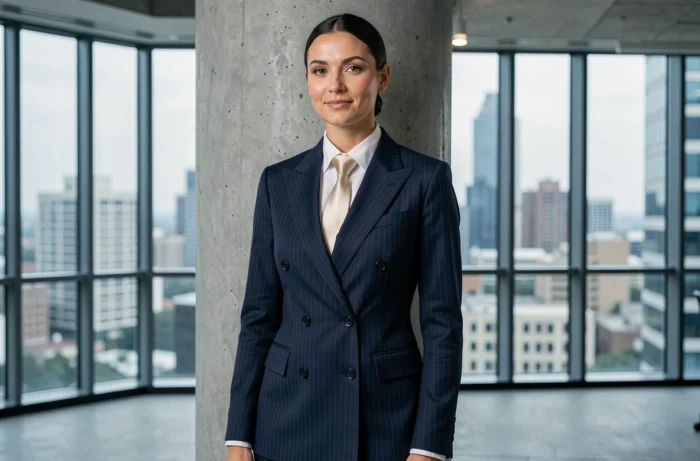
Slim silk tie + fluid midi dress. The tie structures the upper body while the dress adds movement below. Choose a tie in a tone present in the dress’s print to avoid a flat effect.
Knitted tie + wide jeans + oversized blazer. The vibe remains casual thanks to the knit and denim. The blazer frames the whole. Keep flat shoes (loafers, white sneakers) to avoid overloading.
Patterned cotton tie + solid shirt tucked into high-waisted pants. Here, the tie becomes the only patterned piece of the look. It captures the eye without competition. One patterned element per outfit avoids visual overload.
Trendy tie: mistakes to spot before heading out
The women’s tie works when it looks natural. A few signals indicate that the look leans the wrong way.
A knot that is too tight and pulled up to the last button mimics a corporate dress code. Unless you explicitly aim for this register, loosen it. A tie end sticking out under the jacket or belt disrupts the proportions. Tuck the narrow end into the back loop (most ties have one) to keep it in place.
In terms of color, solid dark shades (black, navy, burgundy) remain the most versatile. Highly contrasting geometric patterns work but require a strictly solid top to breathe.
This season, the women’s tie does not require extreme boldness or a specific wardrobe. A slim tie in a material consistent with the rest of the outfit, a loose knot or no knot at all, and monitored proportions: these three guidelines transform an intimidating accessory into a mastered style detail.