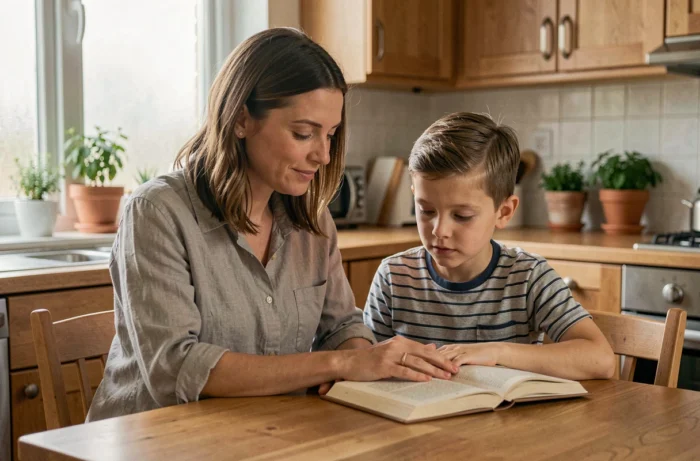
A child crying in the supermarket, a teenager locked in silence, a couple who can no longer talk to each other after 9 PM: supporting parents on a daily basis starts with recognizing that these situations are nothing exceptional. Parenting requires relational skills that no one teaches in school, and the responses vary depending on the child’s age, family configuration, and the level of accumulated fatigue.
Parental mental load: what daily rhythms produce on the parent-child relationship
Have you ever noticed that the same child can be cooperative in the morning and unmanageable in the evening? The quality of the parent-child relationship fluctuates with the available energy level, not with goodwill.
The parental mental load refers to all the invisible tasks: anticipating medical appointments, planning meals, managing school registrations, mediating conflicts between siblings. This invisible load exhausts even before concrete action. When a parent arrives overwhelmed in front of their child, their listening capacity decreases. Reactions become automatic: raising their voice, threatening, giving in for peace.
Identifying the moments of the day when tension rises allows for reorganizing daily life differently. For example, preparing clothes and bags the night before reduces morning pressure. Shifting bath time by half an hour can be enough to avoid the time slot when everyone breaks down. These adjustments, seemingly trivial, protect the parent’s emotional availability for the moments that really matter.
Since the decree of May 15, 2025, a medical prescription is no longer mandatory to access the “Mon soutien psy” program. The cap has been raised to 12 reimbursed sessions per year, making psychological support more accessible to struggling parents. Several families can consult the resources of Un P’tit Air de Famille to find additional avenues suited to their situation.

Peer parental support: local collectives that make a difference
Books on positive psychology and specialized Instagram accounts provide ideas, but they cannot replace the perspective of another parent going through the same ordeal. Peer support reduces feelings of isolation much more effectively than theoretical advice.
Local support collectives are forming in several French cities. In Nantes, the metropolis lists very concrete formats: free outdoor meetings, discussion groups, thematic workshops on screens or school bullying, anonymous gatherings over coffee. These initiatives work because they rely on regularity and geographical proximity.
What distinguishes an effective support group
- A regular framework (same place, same time slot) that allows for building a trusting relationship among participants
- Specific themes rather than open discussions, so that each meeting brings a concrete element to apply at home
- The absence of judgment on educational practices: a parent who shouts does not need to be told that shouting is bad; they need help finding a realistic alternative
This peer-to-peer model does not replace professional follow-up when the situation requires it, but it fills a gap that institutional systems do not always cover.
Birth leave and parenting in the workplace: what changes for families
The law of December 30, 2025, on the financing of Social Security for 2026 introduced an additional birth leave, effective since July 1, 2026. This new measure modifies the organization of the return to professional life for both parents.
However, the first months of implementation revealed some hiccups. Some parents reported delays in the payment of benefits, complicating family budget management at a time when expenses are increasing. Before relying on this income, it is better to anticipate a processing delay.
Work life and family life: two concrete trade-offs
The first trade-off concerns the duration of the leave. A longer leave preserves the parent-child bond in the early months, but it can hinder professional trajectory if the company does not have a return plan in place. Asking the HR department about this before the birth, in writing, creates a useful record.
The second concerns professional training. Several companies, particularly in the Lyon region, offer arrangements for parent employees: flexible hours, partial remote work, easier access to short training courses. Negotiating these conditions before returning avoids having to request them urgently after a few weeks of exhaustion.

Support for parents of children with disabilities
Parental support takes on a particular dimension when a child has a disability. A dedicated system allows for follow-up that can start before birth and continue until the child reaches adulthood.
This long journey requires coordination among health professionals, educators, and family. The parent becomes a permanent interlocutor in the medico-educational system, adding a considerable administrative layer to an already demanding daily life.
Two points deserve special attention:
- The early diagnosis changes the trajectory of support. The earlier adaptations are put in place (occupational therapy, speech therapy, school adjustments), the more autonomy the child gains
- Parental burnout in these situations is documented and recognized. Asking for help (temporary care, home assistance) is not an admission of failure but a lever to endure over time
- Parent collectives, often organized by pathology or territory, provide a space where lived expertise complements medical expertise
A thriving family life is not measured by the absence of difficulties. It depends on each parent’s ability to recognize their limits, seek support at the right time, and adjust their expectations to the reality of their daily life, not to an idealized model.