Since January 1, 2024, the minimum age to obtain a category B driving license and drive alone has been lowered to 17 years in France. This reform, announced as part of the National Council for the Refoundation dedicated to youth, blurs the lines for families who still associate the age of 16 with a possible driving license. The French regulatory framework distinguishes several provisions accessible to minors, and 16 years does not grant the same rights as 17 years.
Category A1 and AM licenses: what a 16-year-old can actually drive
The category B license is not accessible at 16, neither for the practical exam nor for independent driving. However, two categories of licenses are available at this age, and they pertain to vehicles quite different from a car.
The A1 license is available from the age of 16. It allows the driving of a light motorcycle with an engine capacity not exceeding 125 cm³. This license requires passing a theoretical exam (the motorcycle code) and a specific practical exam. It is the only license that gives a 16-year-old the possibility to ride alone on open roads with a motorized two-wheeled vehicle of this category.
The AM license, on the other hand, is accessible from the age of 14. It allows the driving of a moped (maximum 50 cm³) or a car without a license. At 16, this license is therefore already obtained for many young people who passed it earlier.
For those aiming for a car, understanding the conditions for obtaining a driving license at 16 helps distinguish what pertains to preparation for the category B license from what actually allows one to take the wheel.
Early learning of driving from the age of 15: the path to the B license
While driving a car alone remains impossible at 16, preparation for the category B license can begin well before turning 17. Early learning of driving (AAC) is open from the age of 15. It is the most structured program for minors who want to anticipate obtaining their license.
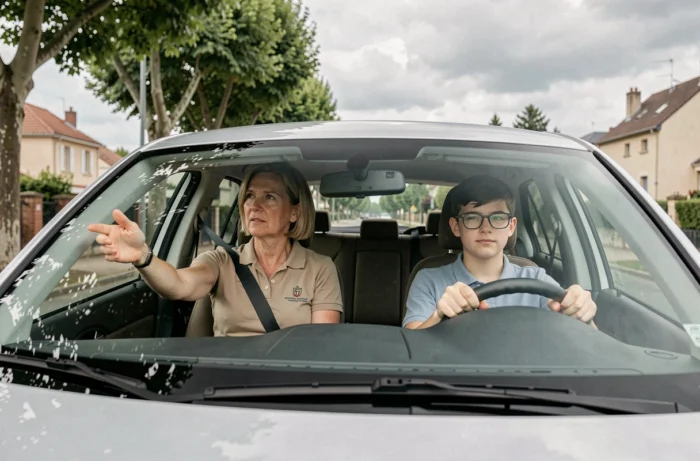
The AAC program takes place in several distinct phases:
- An initial training in a driving school, including a minimum number of driving hours and the validation of the general theoretical exam (the highway code), accessible from the age of 15.
- The issuance of the initial training completion certificate (AFFI), given by the driving instructor when the required level is reached.
- A phase of accompanied driving with a supervisor who has held a category B license for at least five years, during which the young person must cover a significant distance over a minimum duration of one year.
At the end of this phase, the practical exam for the category B license can be taken from the age of 17 since the reform of January 2024. Before this date, one had to wait until 18 to drive alone, even after passing the exam at 17 and a half.
Accompanied driving should not be confused with supervised driving, which is aimed at candidates aged 18 and over, nor with structured driving, reserved for students in vocational training related to road professions. These three programs follow different rules, and confusing them is a common mistake.
Normal residency condition: an overlooked criterion for young candidates
A point rarely addressed in mainstream content concerns the administrative residency condition. The Highway Code requires all candidates for a driving license to justify a normal residency in France, defined as a habitual stay of at least 185 days per year.
This requirement can pose a concrete obstacle for families recently settled in France or for young people of foreign nationality. Depending on the situation, a valid residence permit may also be required. This criterion applies to all categories of licenses, including the AM and A1 licenses.
For a 16-year-old wishing to enroll in a driving school and start the AAC, the verification of this condition occurs as soon as the application is submitted. A lack of proof can block the entire process, regardless of the candidate’s age or level of preparation.
Category B at 17 and probationary period: what changes after the reform
The reform that came into effect on January 1, 2024, changed the age for obtaining the category B license, but it did not affect the probationary period. Every new driver has an initial capital of 6 points on their license, regardless of their age at the time of obtaining it.
The duration of this probationary period varies depending on the path taken:
- Three years for candidates from the traditional training.
- Two years for those who have followed the early learning of driving (AAC), an advantage often cited in favor of this program.
- During this period, specific limitations apply, particularly regarding the maximum speed allowed.
The more recent RIPOST law has also introduced restrictions on the power of vehicles accessible to young drivers. These provisions add to the rules of the probationary period and limit access to the most powerful cars during the first years of the license.
A 17-year-old driver holding a category B license is therefore subject to a more stringent framework than an experienced driver, both in terms of points capital and authorized vehicles. The reform has advanced the age of independent driving without easing the obligations that govern it.
For young people considering starting their journey at 16, AAC remains the only path to reduce the probationary period to two years. Traditional training, accessible at 16 for the theoretical part, only allows access to the practical exam from 17 and imposes a longer probationary period. The choice of training path therefore has direct consequences on the first years of driving.