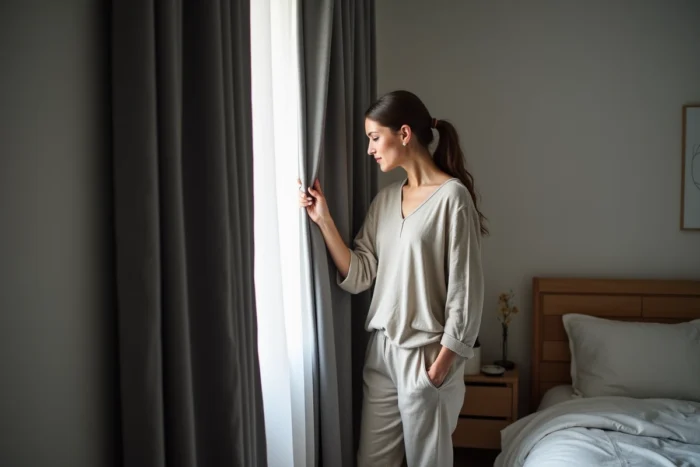
Your blackout curtains let a halo of light filter in around the edges, or the room remains warm despite the fabric being closed in the middle of the afternoon. Before replacing them, a few simple tests can measure their actual performance, both in terms of light and heat. Understanding where the leaks are makes a difference: sometimes the curtain is fine, but its installation is the problem.
Measure the temperature of the glass with an infrared thermometer
Have you ever placed your hand on a window in the middle of summer, with the curtain closed, and felt that the glass was burning hot? This subjective feeling can be turned into usable data with a very simple tool: an infrared thermometer, also known as a pyrometer.
These devices, available for a few dozen euros at hardware stores, measure the surface temperature of the glazing without contact. The protocol consists of three steps.
- Open the curtain and point the thermometer at the center of the glass in full sunlight. Note the value.
- Close the blackout curtain, wait about fifteen minutes for the temperature to stabilize, then measure the glass again (by placing your hand behind the fabric).
- Also measure the ambient air temperature one meter from the window, with the curtain open and then closed, to assess the impact on the room itself.
A well-functioning curtain creates a clear gap between the exposed glass and the air on the room side. If the difference remains small, the fabric allows too much thermal radiation to pass through, or warm air circulates freely between the curtain and the glass at the sides and top. An article detailing the effectiveness of blackout curtains on Direct Maison delves into this measurement logic for different types of fabrics.
This test is valid for both summer and winter. In cold seasons, measure the temperature of the glass on the interior side: a high-performing blackout curtain limits the cold wall sensation that prompts you to turn up the heating.
Light test with a smartphone: detect blackout leaks
Perfect blackout, which plunges a room into complete darkness, depends as much on the fabric as on how it covers the window. To precisely identify weak areas, a smartphone is sufficient.
Backlight test with the flashlight
Position yourself on the room side, with the curtain closed, in a room as dark as possible. Ask someone to shine the phone’s flashlight on the fabric from outside (or from the other side if you can’t go outside). Observe where the light penetrates.
A truly blackout fabric does not let any light points through its fibers. If you see a diffuse halo in the center of the panel, the fabric lacks density or its opaque layer (coating, black lining) is too thin.
Map the side leaks
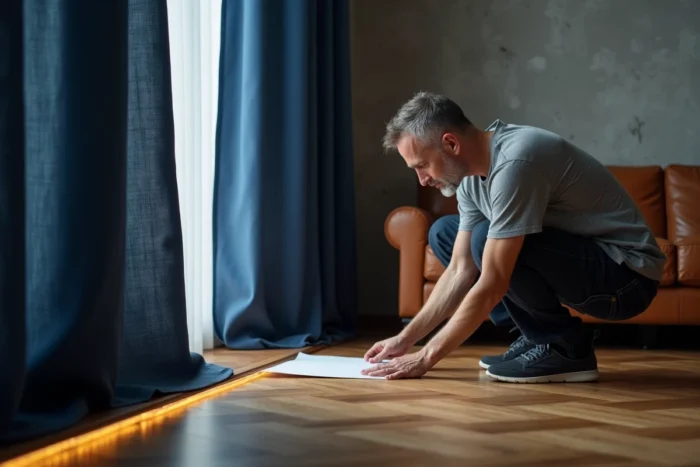
In broad daylight, close the curtain and take a photo with your phone in HDR mode or automatic exposure. The image reveals the light bands on the sides, top, and bottom, where the fabric does not cover the window frame.
Side leaks often represent the real problem, not the fabric itself. A curtain that is too narrow or a rod that is too short lets in enough light to disrupt sleep, even if the textile blocks all radiation.
Note the width of each light band. Beyond two centimeters on each side, the blackout is significantly compromised.
Evaluate the quality of the blackout fabric without equipment
Don’t have an infrared thermometer on hand? Two tactile manipulations already provide reliable indications.
Fold the curtain in two layers and place your hand behind it, facing a light source (window or lamp). If your hand remains invisible in double thickness, the fabric offers good opacity. Conversely, if you can see your fingers even through two layers, the actual blackout will be poor.
Then rub the fabric between your fingers. A quality blackout has a certain weight, a density that can be felt to the touch. Lightweight and soft fabrics are pleasant, but they rarely compensate for their thinness with sufficient coating. The presence of a thermal lining bonded to the fabric (sewn or laminated, not just placed behind) improves both insulation and light blocking.
Timing strategy: when closing the curtain makes all the difference
A high-performing blackout curtain, if misused, yields disappointing results. The most common mistake is closing the curtains only when the heat is already established in the room.
The logic is the same as for roller shutters: close before the sun hits the window directly, not after. On a south-facing facade, this means closing by late morning in summer. On a west-facing facade, by early afternoon.
To test if your strategy works, compare two similar days (same weather, same orientation). On the first day, close the curtains only when you feel the heat. On the second, close them one to two hours before direct sunlight. Measure the room temperature at the end of the afternoon in both cases.
The difference can be significant, especially on old single or double-glazed windows, where the blackout curtain acts as an additional layer of thermal resistance. Combined with nighttime ventilation (opening windows at night to expel accumulated heat), this protocol allows for a precise assessment of the curtain’s contribution to your comfort, independent of the rest of the insulation.
Keep in mind that a curtain alone does not replace an exterior shutter. It slows down radiation, but the glass continues to heat up. The infrared thermometer test described above allows you to quantify this limit.
Testing your blackout curtains takes less than an hour and costs almost nothing. If the results show a correct fabric but side leaks, the solution lies in a wider rod or wall returns, not in a new curtain. If the fabric is the issue, opt for a model with an integrated thermal lining and a sufficiently dense weight to block both light and heat.