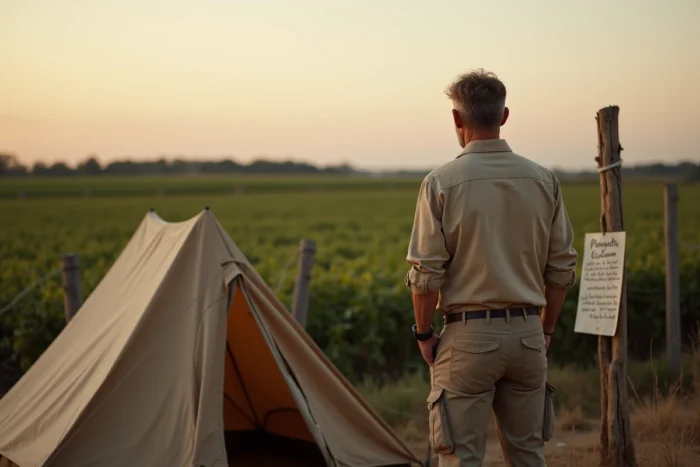
You have spotted a quiet agricultural plot, far from everything. The idea of setting up a tent, a van, or a small cabin to spend the night seems simple. The legal reality is much less so. A plot classified as agricultural in the local urban planning plan is subject to strict rules, and sleeping there, even for just one night, can pose problems depending on the nature of this occupation.
Criminal protection and unenclosed agricultural land: an unknown gray area
Most online guides discuss construction or permits. Few address a more concrete angle: what happens if someone settles on your agricultural plot, or if you sleep there without having a recognized building?
On unenclosed agricultural land, the criminal protection of the home is much weaker than in a house. In practice, illegal occupation of the land falls under civil proceedings and not criminal proceedings for violation of domicile. In other words, if a third party squats on your plot, the process to evict them will be longer and more costly than for a house occupied illegally.
This point changes the game for anyone considering sleeping legally on agricultural land: without a recognized dwelling, you do not benefit from the protective status of the home. The land remains a simple rural asset in the eyes of criminal law.
Agricultural zone and urban planning: what the PLU really allows for sleeping
The local urban planning plan classifies agricultural plots in zone A. In principle, construction and development are prohibited. The PLU regulations may provide for exceptions, but they remain tightly controlled.
Are you a farmer and need to live on-site to monitor livestock or manage a seasonal activity? The PLU may allow for the construction of a dwelling linked to the operation. The town hall and the departmental commission for the preservation of natural spaces then examine the file.
For a non-farmer, options are virtually nonexistent. Installing a garden shed, placing a mobile home, or setting up a yurt is not simply a personal choice. Each of these situations requires a planning permission application submitted to the town hall.
Cases that require authorization
- A small shelter or construction (even a few square meters): a prior declaration is required as soon as the structure is fixed to the ground or intended to remain in place.
- A lightweight or removable habitat (tiny house, yurt, non-anchored cabin): the regime depends on the duration of installation and the removable nature, but the town hall remains competent to check compliance with the PLU.
- A mobile home or a recreational vehicle: even without a foundation, their prolonged parking on agricultural land can be reclassified as illegal occupation of the land.
Cabinization on agricultural land: the concrete risks of sanctions
Since 2023-2024, several prefectures have been conducting targeted campaigns against the cabinization of agricultural and recreational land. The phenomenon targets the gradual installation of cabins, tiny houses, or mobile homes on non-buildable plots, without authorization.
The Pyrénées-Orientales prefecture has publicly communicated about its “determined mobilization against cabinization,” with forced demolitions and financial penalties involved. This is not an isolated case: other departments are following the same logic.
Why are these campaigns intensifying? Because cabinization encroaches on agricultural land and creates problematic sanitary situations (no connections to networks, no sanitation). The penalties are not theoretical.
What you risk concretely
- A report of violation of the urban planning code, drawn up by the town hall or the departmental directorate of territories.
- An obligation to restore the land, meaning the demolition or removal of any installation, at your expense.
- Daily financial penalties as long as the situation is not regularized, which can accumulate over several months.
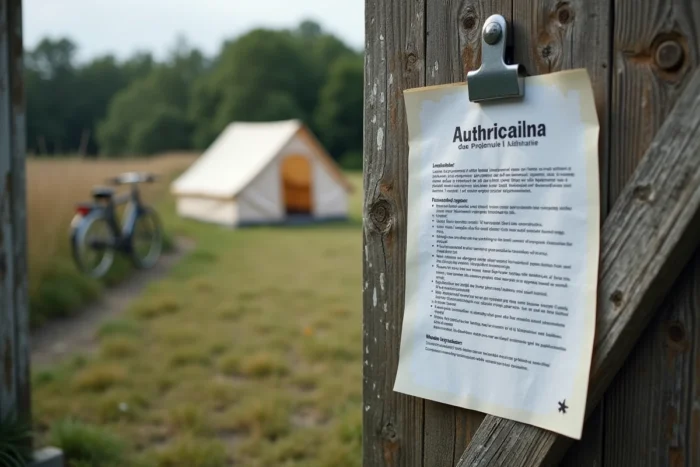
Mobile residence and lightweight shelter in agricultural zone: a distinct but regulated regime
Mobile or removable residences (mobile home, small non-anchored cabin, shelter of less than five square meters) escape certain obligations. They are not subject to energy performance diagnostics, for example, and may fall under a distinct urban planning regime from that of permanent buildings.
But “distinct regime” does not mean “free of any rules.” Parking a mobile home for more than three months a year on agricultural land requires authorization. The removable nature does not protect against scrutiny if the installation becomes habitual.
In practice, the line between “sleeping occasionally” and “living” is judged by a set of indicators: connection to water or electricity, presence of permanent furniture, mail received on-site. The more the occupation resembles a residence, the greater the legal risk.
What to do before sleeping on agricultural land
First, consult the PLU of the municipality at the town hall or online. Identify the exact zoning of the plot. If it is classified in zone A, assume that any installation is prohibited unless documented exceptions are stated in the regulations.
For a farmer wishing to live on their farm, the urban planning authorization file must demonstrate that presence on-site is necessary for the operation of the activity. A farmer who needs to intervene at night with their animals has a valid argument. A market gardener whose greenhouses are ten minutes from their home, much less so.
For a non-farmer, the only legal route is through a modification of the PLU or a reclassification of the plot, both lengthy procedures with no guarantee of results. The temptation to settle “in the meantime” exposes one to the sanctions described above, including demolition ordered by the court.
The agricultural land remains a production tool protected by French law. Sleeping there, even temporarily, is not trivial as soon as the occupation becomes visible or repeated. Checking the zoning, submitting the necessary permits, and anticipating prefectural controls remains the only sustainable approach.