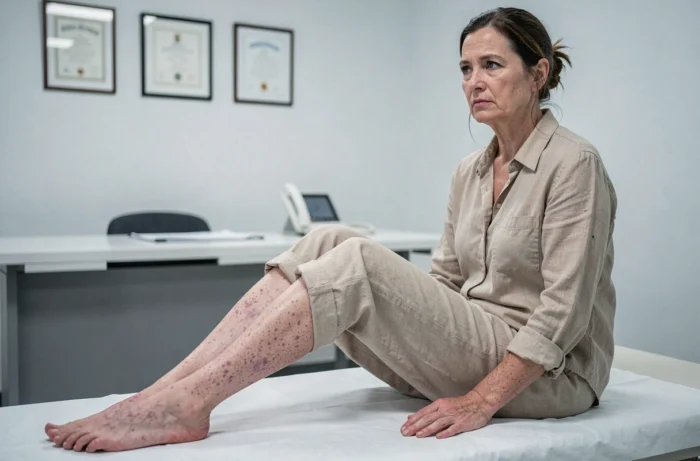
Marbled skin refers to a network of purplish or reddish lines visible on the surface of the skin, most often on the legs. This pattern, known as livedo in dermatology, indicates a change in blood flow in the small cutaneous vessels. Most of the time benign and triggered by cold, it can also signal a vascular disorder or a systemic disease when certain specific characteristics are present.
Livedo reticularis and livedo racemosa: two patterns, two levels of risk
The distinction between these two forms of livedo is crucial for the entire medical approach. Confusing them is akin to comparing a transient chill to a chronic fever.
Livedo reticularis creates a regular and symmetrical network on the legs, sometimes the arms. The meshes are closed, uniform, and disappear within minutes when the skin warms up. This type of marbling is a simple vasomotor reaction to cold: the cutaneous arterioles constrict, venous blood briefly stagnates in the superficial plexuses, and the pattern appears.
Livedo racemosa has a very different appearance. The lines are irregular, open, often asymmetrical. The pattern persists even at room temperature and may be accompanied by pain or a hardened appearance of the skin. Recent clinical syntheses consider this form to be much more specific for pro-thrombotic diseases, particularly antiphospholipid syndrome, with an increased risk of thrombotic events and skin ulcers.
In the presence of marbled skin and spots on the legs that do not disappear upon warming, prompt medical advice can help differentiate between these two forms and guide further examinations.
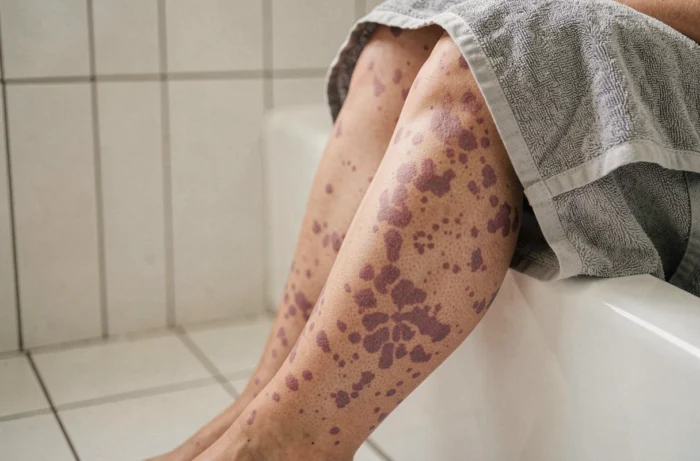
Common causes of marbling on the legs in adults
Cold remains the most frequent trigger. People with fair skin, women, and slender figures are more exposed, as the subcutaneous fat layer, which insulates the vessels, is thinner.
Other factors can provoke or worsen these marblings without any underlying disease:
- Venous microcirculation disorders related to prolonged standing, which slow down blood return in the lower limbs and accentuate the reticular pattern.
- Certain vasoconstrictor or immunosuppressant medications, whose effects on arteriolar tone promote superficial venous stagnation.
- Dehydration, which reduces plasma volume and makes superficial vessels more visible, especially in older individuals.
In infants, marbled skin is very common in the first days of life. The newborn’s thermoregulation system is still immature: cutaneous vessels react excessively to temperature variations, producing diffuse marbling on the trunk and limbs. This phenomenon usually disappears within a few weeks without treatment.
Persistent marbling and link with COVID: what recent studies show
Recent studies have highlighted that cutaneous vascular lesions (purpura, livedo, necrosis) may contain SARS-CoV-2 Spike protein at the level of the vascular endothelium. This presence has been detected not only during acute infection but also after a prolonged period following infection or vaccination.
The retrospective case-control study using immunofluorescence strengthens the hypothesis of lasting microvascular damage in some patients. The resulting persistent microthromboses could explain chronic skin marbling in individuals without a known vascular history.
This link between livedo and the post-infectious context also aligns with data on antiphospholipid syndrome. Recent reviews remind us that livedo racemosa is a clinical alert marker for this syndrome, even outside the classic diagnostic criteria. Post-COVID endothelial inflammation could therefore mimic or trigger a similar mechanism.

Spots on the legs: five signals that warrant prompt consultation
Not all marblings require a doctor’s appointment. Benign livedo reticularis disappears upon warming and is not accompanied by any other symptoms. However, several elements should raise concern:
- An irregular, asymmetrical pattern, with open meshes that do not form a homogeneous network.
- Marblings that persist in a warm environment, without exposure to cold.
- The appearance of fixed brown or purplish spots, distinct from the reticular network, suggesting purpura or hemosiderin deposits.
- Local pain, a burning sensation, or hardening of the skin at the site of the marbling.
- The simultaneous presence of fever, unusual fatigue, or joint pain, which points towards a systemic disease.
A dermatologist or angiologist can confirm the nature of the livedo through a clinical examination, supplemented if necessary by a blood test (search for antiphospholipid antibodies, inflammatory markers).
Pigment spots and marbling: do not confuse
Brown spots that appear on the legs with age (solar lentigos, hemosiderin deposits related to venous insufficiency) have nothing to do with livedo. Their mechanism is different: accumulation of melanin or iron in the dermis, not arteriolar spasm. A fixed spot that changes shape or color warrants a dermatological opinion, regardless of the presence or absence of marbling.
The most reliable reflex remains the warming test. If the patterns completely fade after a few minutes in a warm room or under a blanket, the situation is almost always benign. A livedo that resists this test deserves further exploration, regardless of the patient’s age.