
The word “leisure” encompasses any activity freely chosen outside of constrained time (work, domestic obligations, sleep). This definition, used in time-use surveys, allows us to measure what each person actually does with their available hours. In the United States, a document from the Video Advertising Bureau based on the American Time Use Survey 2025 shows that video alone accounts for half of the daily leisure budget of individuals aged 15 and older, marking the fourth consecutive year of this trend. This observation raises a concrete question: how to allocate free time so that it has a tangible effect on health, curiosity, and social connections.
Digital Leisure: Screen Time That Eats Into Other Activities
The time dedicated to gaming and recreational computer use has increased over the long term compared to 2015, according to the American Time Use Survey 2025. This sustained rise is not merely a trend linked to lockdowns: interactive digital leisure is structurally embedding itself into schedules.
The issue is not the screen itself. Watching a documentary, taking an online course, or playing a strategy game stimulates the mind. The imbalance appears when a single category absorbs the majority of free time, to the detriment of reading, sports, or shared moments with loved ones.
To gain clarity, simply noting the time spent on each leisure activity for a week is sufficient. A simple paper table with three columns (activity, duration, satisfaction felt) often reveals a gap between what one thinks they are doing and what they are actually doing. This awareness is the starting point for rebalancing, and the leisure section of Le blog de Bango offers concrete ideas for diversifying daily activities.

Body, Creativity, and Mind Trio: A Framework for Leisure Activities
Psychologist Mark Travers, in an article published in 2025 in Psychology Today, argues that a balance between three families of activities fosters personal growth: a physical leisure activity, a creative leisure activity, and an intellectual leisure activity. This simple framework allows one to check if their free time covers multiple areas or focuses on just one.
Physical Activity: The Physiological Foundation
Walking, swimming, cycling, yoga, dancing: the form matters less than the regularity. Two or three sessions per week, even if short, improve sleep quality and stress resistance. Sports practiced with friends or family add a social dimension that enhances motivation.
Creative Activity: Producing Rather Than Consuming
Drawing, writing, elaborate cooking, music, DIY, gardening: these activities share the commonality of focusing attention on a production process. The result matters less than the state of concentration they provide. Unlike passive scrolling, creation engages working memory and generates a measurable sense of accomplishment by the end of the session.
Intellectual Activity: Nurturing Curiosity
Reading, complex board games, learning a language, background podcasts: this area stimulates reflection and knowledge acquisition. The idea is not to turn every evening into a lecture, but to dedicate a few slots each week to a subject that requires voluntary cognitive effort.
Screen Regulation for Youth: What’s Changing in France
A law passed in July 2026 established a strengthened regulation of social networks for those under 15 and a ban on mobile phones in high schools, set to be implemented at the start of the school year. This measure directly alters the leisure activities of children and teenagers both at home and at school.
For families, this means anticipating alternatives. A teenager deprived of a phone during the school day will need substitute activities in the evening and on weekends. The question is no longer “should we limit screens” but “what should replace the freed-up time.”
Here are some effective ideas that require no special budget:
- Establish a daily reading slot of twenty to thirty minutes at the same time to create a routine. Municipal libraries lend books, comics, and magazines for free.
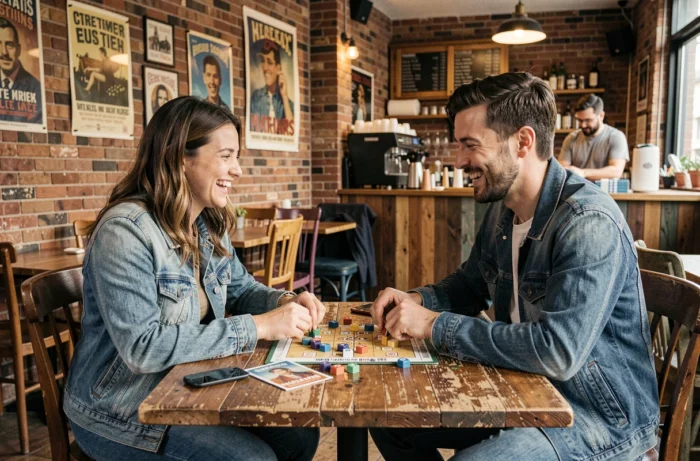
- Offer a board game during the week (not just on weekends). Cooperative games reduce tensions between siblings and encourage strategic thinking.
- Start a creative project over several weeks (a model, a fictional travel journal, recipes from a different country each week) to maintain long-term engagement.
Planning Leisure Without Turning Your Week into a Rigid Schedule
Blocking out free time in a calendar may seem contradictory. The goal is not to plan every minute but to protect slots from being overwhelmed by obligations. Without this protection, leisure time is systematically the first to be sacrificed.
A simple method is to set two or three non-negotiable appointments per week with oneself or with loved ones: a sports outing, a creative workshop, a game night. The rest of the free time remains spontaneous.
A common mistake is to overload this protected time. It’s better to have one enjoyable activity practiced regularly than five hobbies started and then abandoned. Regularity produces more satisfaction than forced variety.
Sociologist Ulrich Reinhardt, quoted in the Swiss daily Blick, warns against overly “optimized” leisure: wanting to maximize every free hour generates pressure that negates the sought-after benefit. Keeping empty slots, without a plan, is part of the equation.
The ideal distribution depends on individual constraints (work hours, presence of children, budget, living location). The only reliable criterion remains the feeling at the end of the week: if free time has produced energy rather than fatigue, the balance is likely correct. Conversely, moving just one activity, replacing another, or simply removing one often suffices to correct the course.