
Opening a jar, getting up from a low chair, reaching for an object up high: these seemingly trivial actions can sometimes become a real puzzle with age. Choosing the right equipment for seniors in daily life is not just about browsing a catalog of medical supplies. The starting point is to precisely identify the actions that pose problems, then find the object or arrangement that restores autonomy without complicating life.
Assessing daily actions before purchasing equipment
Most competitors list products by room in the house. This approach has a flaw: it encourages buying too much, too soon, and sometimes poorly suited items. Starting from the problematic action allows for more accurate targeting.
Have you noticed that difficulty getting up from the couch does not call for the same response as a loss of balance in the shower? In the first case, a lift cushion or a rise-and-recline chair solves the problem. In the second, it’s a non-slip shower seat combined with a grab bar that makes the difference.
An occupational therapist can conduct a home assessment to identify risky situations room by room. This evaluation leads to specific recommendations and often conditions access to financial aid such as the personalized autonomy allowance (APA). To find information on Seniors des Infos, the process starts with this functional diagnosis, not with the choice of product.
A useful piece of equipment is one that addresses an identified difficult action. If no one has assessed the situation, the risk is investing in equipment that ends up in the closet.
Indoor mobility aids: choosing according to the level of movement
Mobility at home accounts for the majority of falls. Narrow hallways, door thresholds, slippery rugs: the home environment is rarely designed for hesitant walking.

Cane, walker, or rollator
A cane is suitable when balance is slightly impaired but leg strength remains adequate. As soon as muscle fatigue sets in or the person needs to put their weight on a support, the walker takes over.
The rollator (a wheeled walker with brakes and an integrated seat) offers an interesting compromise for mixed indoor-outdoor mobility. The choice depends on the actual walking range, not age. A very active 75-year-old does not have the same needs as a 68-year-old in post-operative rehabilitation.
Wheelchair or electric scooter
When the walking range is significantly reduced, healthcare professionals increasingly direct towards motorized solutions, even for short trips around the home. Home autonomy services (SAD), created by the decree of July 13, 2023, can now assist with travel beyond the home (shopping, leisure, civic life), which expands the usage framework of this equipment.
A point of caution: as of March 1, 2026, only about 13% of former SSIAD had converted to mixed SAD. Coordinated access to equipment varies greatly by region. Check with your department to find out the competent local service.
Safety in the bathroom and toilets: important technical criteria
The bathroom remains the most dangerous room in the home for seniors. Humidity, smooth surfaces, and transfer movements (getting into the shower, sitting on the toilet) concentrate the risks.
Here are the criteria to check before purchasing equipment for this room:
- The shower seat must support at least the user’s weight plus 20%, with suction cup feet or wall-mounted, and a certified non-slip surface.
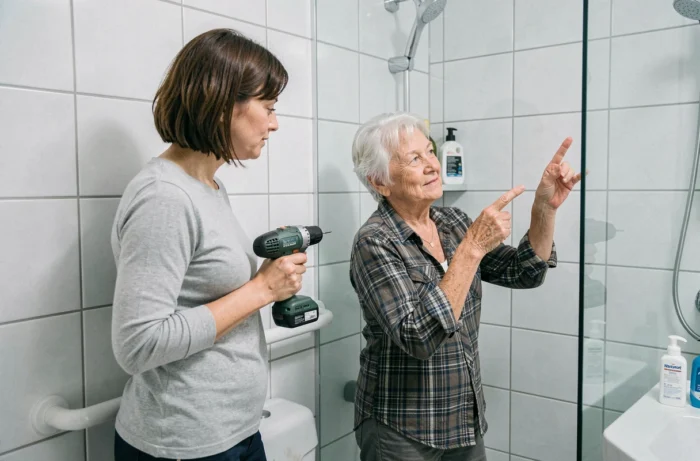
- Grab bars should be fixed to a load-bearing wall or an appropriate reinforcement, never just by suction cup if the person is putting their full weight on it to stand up.
- The toilet riser must be compatible with the shape of the bowl (round or elongated) and have armrests if the person lacks strength in their arms to rise.
- A medical-grade non-slip mat is distinguished from a regular bath mat by its slip resistance measured according to a specific standard.
Installing a grab bar in a hollow wall without reinforcement is a common mistake that can cause it to tear out during a sudden support. A craftsman or occupational therapist checks the nature of the wall before installation.
Funding and coverage: what the APA really covers
The APA finances part of the equipment, but only those listed in the aid plan developed after assessment by the departmental medico-social team. A lift chair purchased without this prior evaluation will generally not be reimbursed.
Social security covers certain medical devices (wheelchair, hospital bed) on prescription. Health insurance can cover the remaining costs, with very variable ceilings from one contract to another. Check your mutual insurance contract before the purchase, not after.
Retirement funds also offer assistance for housing adaptation, distinct from the APA. These aids can be combined under certain income conditions. The Mon Parcours Handicap platform lists available technical aids, including for the elderly.
Common pitfalls when choosing senior equipment
Buying overly sophisticated equipment discourages use. An ultra-light carbon walker is useless if the person does not understand the braking system. Simplicity of use takes precedence over technical performance.
Here are some recurring mistakes to avoid:
- Ordering online without trying: the height of a cane, the width of a walker, or the comfort of a positioning cushion should be physically verified.
- Neglecting the weight of the equipment: a rollator over 10 kg will be difficult to fold and store for a person alone.
- Ignoring the user’s opinion: equipment imposed without consultation is often abandoned in the weeks that follow.
The right reflex is to borrow or rent the equipment for a few days before purchasing it. Some medical supply providers offer this option, allowing you to validate the choice in real conditions.
Suitable equipment does not need to be expensive or high-tech to fulfill its role. An ergonomic jar opener for a few euros can transform a daily meal. What matters is the correspondence between the difficult action and the chosen solution, validated if possible by a professional who understands the person’s situation.