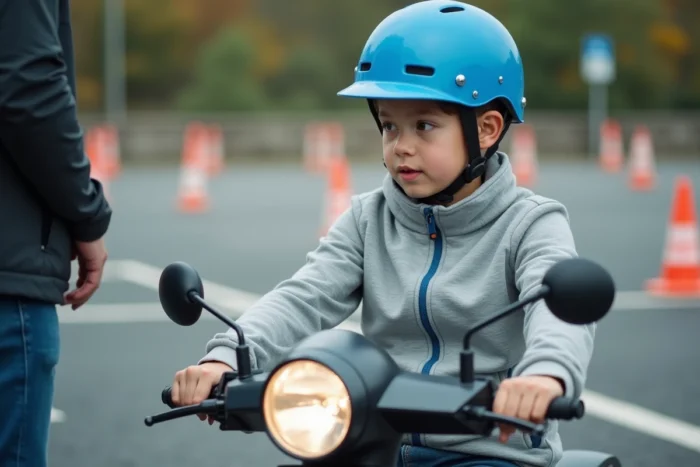
The BSR, now officially called the AM license, allows the driving of a moped or a small car from the age of 14. Contrary to what its former name suggests, it is not just a simple certificate that one can obtain in a day. The training includes a theoretical part validated at school and a practical part at a driving school, and each step has its own pitfalls.
ASSR and ASR: the prerequisite for the BSR that many discover too late
Before even stepping into a driving school, a document conditions the entire process. You must have obtained the ASSR 1 (in 5th grade) or ASSR 2 (in 9th grade). Young people who are no longer in school must take the ASR at a GRETA or an accredited center.
Have you lost your certificate? This is a common case. A duplicate can be requested from the school or, if not possible, from the rectorate. Without this document, the driving school simply cannot open your file.
The ASSR is based on video sequences that show real traffic situations. The exercise assesses risk perception in road conditions, not the memorization of isolated signs. Regular training on the official platforms of the National Education prepares you much better than passive rereading of a course.
If you are wondering about the validity of the BSR once obtained, know that you can lose your BSR with Team Auto Passion by consulting a comprehensive file on situations that may pose problems after training.
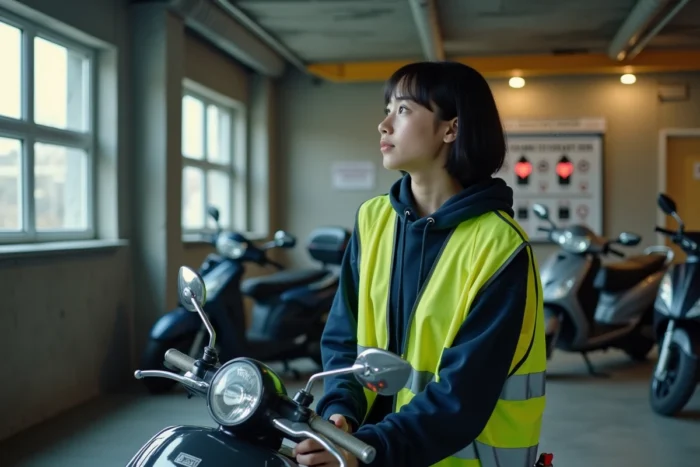
Digital training booklet for the AM license: what to fill out before the first class
As soon as you enroll in a driving school, the candidate receives a digital training booklet containing a questionnaire to complete. This questionnaire is not just an administrative formality: it concerns your travel habits, your relationship with risk, and your basic knowledge of road safety.
Many candidates fill it out hastily, even on the same day as their first practical class. However, the instructor relies on your answers to adapt the session. If you indicate that you master low-speed balance when this is not the case, the progression will be poorly calibrated from the start.
Take about twenty minutes in a quiet place to answer honestly. The booklet is not graded. It serves to build a realistic training path.
Common mistakes during BSR practical training
The practical part of the AM license lasts at least eight hours, spread over at least two days. This volume may seem short, but it covers a dense program. Here are the most common mistakes made on the ground.
- Neglecting emergency braking at low speed: on a moped, the braking distance seems ridiculous. In reality, a front wheel lock on wet ground causes an almost instantaneous fall. The instructor emphasizes the gradual application of the front brake, but candidates rarely practice the exercise between sessions.
- Forgetting visual checks before each change of direction: turning your head to check the blind spot is not a natural reflex on a two-wheeler. Instructors systematically penalize this oversight, as it remains the leading cause of accidents among novice moped drivers.
- Underestimating traffic in urban areas: the training necessarily includes a module in real traffic conditions. Many candidates feel comfortable on the closed plateau, then lose their bearings as soon as they ride among cars. The difference lies in the simultaneous management of trajectory, speed, and observation.
The specific case of the U-turn and the slalom
These two maneuverability exercises pose problems for the majority of candidates. The U-turn requires looking far in the direction of exit, not at the front wheel. The slalom requires maintaining a constant speed and pivoting with the hips rather than with the handlebars.
A practical tip: if your driving school offers an additional plateau session, accept it. Eight hours are enough to validate the training, but not to become comfortable.
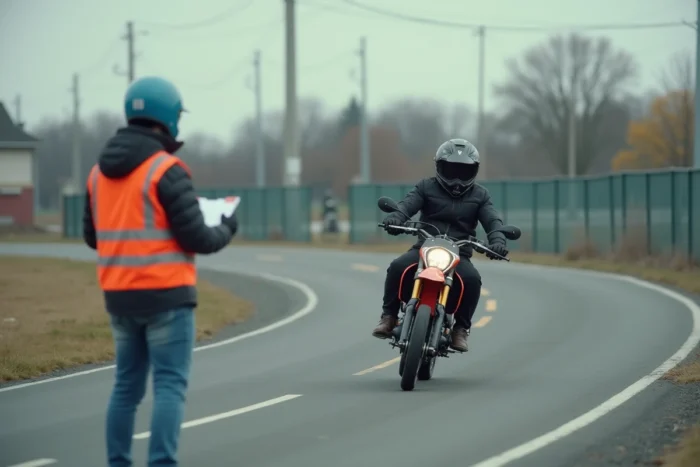
Choosing your driving school for the AM license: concrete criteria
Not all driving schools offer BSR training. Among those that do, the quality varies greatly. Before enrolling, check three specific points.
- The number of places per session: training with six candidates for one instructor leaves little time for individual practice. Prefer groups of three or four.
- The availability of the vehicle: some schools use tired scooters whose braking lacks bite. Ask what model is used and in what condition it is.
- The distribution of hours over several days: a driving school that concentrates the eight hours in one day does not comply with regulations, which require a minimum of two distinct days. This is a warning sign.
Prices vary by region and structure. Compare at least two quotes, checking what is included (equipment, registration fees, ANTS procedures).
After training: ANTS procedure and receipt delay
Once the training is validated, the driving school submits your file on the ANTS platform for the production of the AM license in card format. You do not receive a provisional paper like for the B license.
The production delay can take several weeks. During this period, the training follow-up certificate issued by the driving school serves as proof in case of a check. Keep it with you at all times when riding a moped or small car.
Check that your information on ANTS (address, civil status) is correct before the request. A data entry error can extend processing, sometimes by several additional weeks. The driving school enters the data, but the responsibility for the information lies with you.